
Naples history begins with Parthenope and Neapolis
Naples history has more than one starting point. UNESCO distinguishes Parthenope, also called Palaepolis, in the ninth century BC from the foundation of Neapolis in 470 BC. Keeping those stages separate makes the story clearer than assigning the whole city a single birth date. The later name belongs to a new foundation within a longer history of settlement.
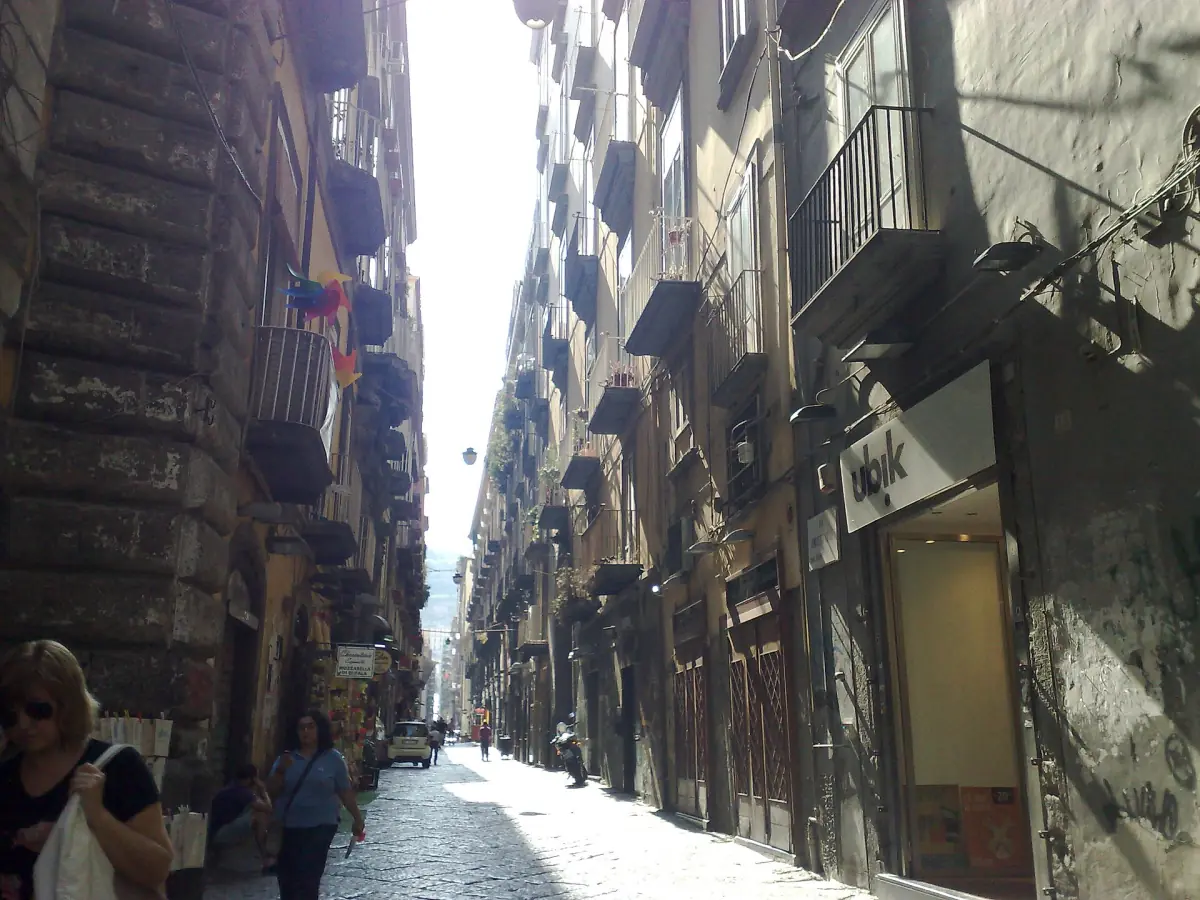
The historic centre is the place to begin reading that story on foot. Its Greek-Roman street plan provides continuity through later periods, even when the buildings around a visitor belong to different times. Look at the direction of the streets as well as the façades. A route through the old town can reveal how an inherited urban layout and subsequent layers of building occupy the same present-day city.

Antiquity in the street plan
The Greek-Roman layout is a useful starting point because it directs attention to the shape of the city rather than to an isolated monument. Naples' destination itineraries follow the Decumani through the historic centre. Use that framework to understand a walk, then give individual buildings their own historical context. An ancient street plan does not mean that every wall along it is ancient.
Spaccanapoli is another useful focus for looking at the relationship between a long street view and the dense old town around it. The aerial photograph makes that relationship easier to see before a visit. For a practical walking route and the choice between exploring independently and joining a guide, continue to the old-town walking guide. This history page supplies the sequence of periods rather than a second set of walking-tour comparisons.
Our picks: History
Our take: A combined city and underground walk adds a guided visit to your history itinerary.
Hand-picked tours, booked through Viator. Prices are indicative starting prices in euros (as of November 2026). Tap a tour for live availability and the current price in your currency.
Old town and underground with a local guide
A combined small-group visit links the city walk with Underground Naples. The 2.5-hour experience includes a local guide, the underground ticket and its guided visit, starting at Piazza Bellini.
From Byzantine and ducal Naples to later rulers
After the Greek and Roman layers, UNESCO's account identifies a Byzantine and ducal period, followed by Angevin, Aragonese and Spanish rule. These changes form the next part of the city's chronology. They are a reason to look for different historical settings within the same walk, rather than treating the centre as the product of one ruler or one building campaign.
UNESCO dates the Angevin period in its account from 1265 to 1442. The subsequent Aragonese and Spanish layers continue the story of changing rule. The Royal Palace is named as a building begun in 1600. Such reference points help organise what can otherwise become a list of names: first understand the order of periods, then attach the places you want to see to that outline.
Castel Nuovo provides a separate place to explore the city's historic interiors. The municipal visit encompasses spaces including the Cappella Palatina, Sala dei Baroni, courtyard and an archaeological route in the former armoury. Some rooms can be unavailable because of institutional use. Read the sightseeing overview for its place in a wider city visit; do not build a day around access to every room.
| Historical focus | Way to explore it | Useful distinction |
|---|---|---|
| Greek-Roman city | Follow the old-town street framework | Street layout and present buildings have different histories |
| Later periods of rule | Read monuments within a chronological outline | The centre contains several historical layers |
| Buried spaces | Choose a specific guided underground route | Separate sites have their own entrances and tickets |
Museums, buried layers and World Heritage
A museum visit adds a different way of approaching the past. The Museo Archeologico Nazionale di Napoli, or MANN, belongs alongside the street walk as an archaeological stop, with its own visiting arrangements. Choose the collections that interest you using the current opening programme. The museum guide helps distinguish a museum visit from the separate guided experiences elsewhere in the city.
Going below street level is another change of perspective. Napoli Sotterranea, Galleria Borbonica and the catacombs are separate visitor sites; they should not be read as one continuous route or booked as though one ticket covers them all. Our underground guide separates the options. The combined experience presented here connects an old-town walk with an underground guided visit, giving that part of the day a shared guide and a defined meeting point.
UNESCO recognition brings these layers into a broader account of the historic centre. Inscribed in 1995, with a boundary modification in 2011, the World Heritage property covers 1,021 hectares. That is the listed heritage area, not the surface area of the entire city of Naples. Treat the designation as a way to understand the importance of the centre's accumulated history, rather than as a promise of entry to individual buildings.
Questions about the city's past
Was Naples founded in 470 BC?
That date refers to Neapolis in UNESCO's account. The same account distinguishes the earlier Parthenope or Palaepolis settlement in the ninth century BC. Both stages belong in an explanation of the city's origins.
Does the UNESCO area cover all of Naples?
The designation concerns the historic centre, with a listed property area of 1,021 hectares. It should not be used as a measurement of the whole modern city. Individual monuments and visitor sites still have their own access arrangements.
Should I start above ground or underground?
For a chronological introduction, we suggest first looking at the street framework, then adding a museum or underground visit. A combined guided walk can connect the surface and underground parts. Choose the route according to your interests and the physical access involved.